Science
At Phoenix Primary, our children are scientists.
Our intent is to provide every child with a broad, ambitious and carefully sequenced Science curriculum, delivered through CUSP, which enables them to confidently explore, question and understand the world around them. We want children to build secure scientific knowledge over time and develop the confidence to think, speak and reason like scientists.
At Phoenix, we want our children to love science. We want them to believe there are no limits to their future — whether they aspire to be astronauts, engineers, forensic scientists, toxicologists, microbiologists or innovators yet to be imagined.
🌟 Our Phoenix Values in Science
🔴 Resilience
Science does not always work the first time. At Phoenix, children learn to persevere when investigations do not go to plan. They refine their methods, rethink their predictions and understand that mistakes are part of discovery.
🔴 Responsibility
Children learn to work safely and respectfully when handling equipment and materials. They take responsibility for accurate observations, honest results and caring for the environment around them.
🔴 Kindness
Science is collaborative. Our children listen to others’ ideas, value different viewpoints and work together respectfully during practical investigations and discussions.
🔴 Ambition
We challenge children to think deeply, use precise scientific vocabulary and strive for excellence in their explanations. We encourage them to see science as a pathway to future careers and limitless possibilities.
Through exciting, practical, hands-on experiences, we spark curiosity and encourage purposeful questioning. Children are taught to observe closely, ask thoughtful questions, carry out fair tests, record findings carefully and draw conclusions using evidence. In doing so, they develop both substantive scientific knowledge and disciplinary skills.
We want our children to remember their science lessons at Phoenix — to cherish the experiments, investigations and discoveries they make. Most importantly, we want them to leave us curious, confident and ready to embrace every scientific opportunity the future holds.
At Phoenix, we are studying CUSP science. Through this pupils become more expert as they progress through the curriculum, accumulating, connecting and making sense of the rich substantive and disciplinary knowledge.
1. What Pupils Will Know – Substantive Knowledge
This is the subject knowledge and explicit vocabulary used to learn about the content. Common misconceptions are explicitly revealed as non-examples and positioned against known and accurate content. In CUSP Science, an extensive and connected knowledge base is constructed so that pupils can use these foundations and integrate them with what they already know. Misconceptions are challenged carefully and in the context of substantive and disciplinary knowledge. In CUSP Science, it is recommended that misconceptions are not introduced too early, as pupils need to construct a mental model in which to position that new knowledge.
2. What Pupils Will Do - Disciplinary Knowledge
This is knowing how to collect, use, interpret, understand and evaluate the evidence from scientific processes. This is taught. It is not assumed that pupils will acquire these skills by luck or hope. Pupils construct understanding by applying substantive knowledge to questioning and planning, observing, performing a range of tests, accurately measuring, comparing through identifying and classifying, using observations and gathering data to help answer questions, explaining and reporting, predicting, concluding, improving, and seeking patterns. We call it ‘Working Scientifically.’ CUSP Science provides Working Scientifically coverage maps to check the balance of provision in KS1, Lower and Upper KS2. They are also present in the Whole Class Assessment toolkits.
Scientific analysis is developed through IPROF criteria. We call it ‘Thinking Scientifically.’
- identifying and classifying
- pattern seeking
- research
- observing over time
- fair and comparative testing
IMPLEMENTATION
CUSP Science is built around the principles of cumulative knowledge. The effect of this cumulative model supports opportunities for children to associate and connect with significant periods of time, people, places and events.
What do we teach?
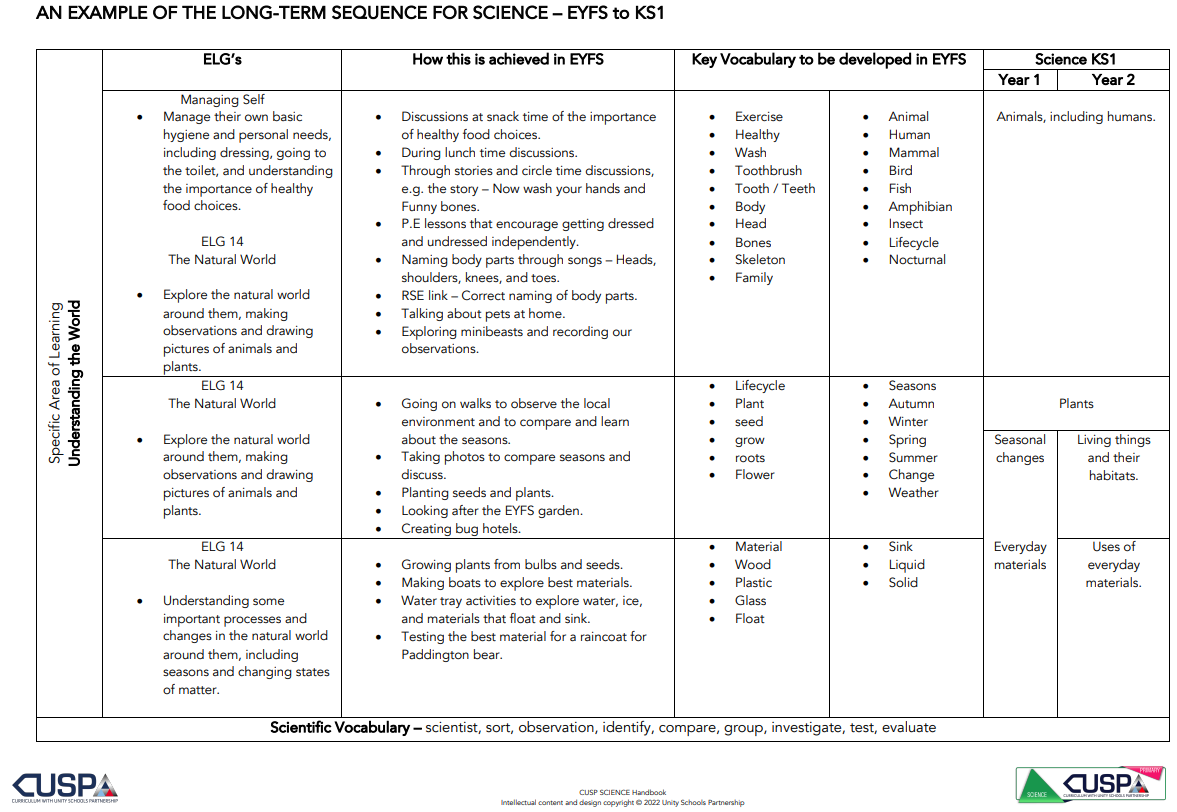
EARLY YEARS FOUNDATION STAGE
In EYFS, Science is developed through Understanding the World. Children explore objects, materials and living things using their senses, noticing similarities, differences, patterns and change. Our carefully planned environment and skilled practitioners nurture curiosity and encourage children to ask questions about how and why things happen. Learning extends beyond the classroom, with regular opportunities to explore the natural world — observing seasonal changes, investigating mini-beasts and learning about plants and animals. Children also take part in practical experiences such as hatching and caring for chicks in the spring term and engaging in cookery sessions, where they observe changes as ingredients are mixed, heated and cooled.
These rich, hands-on experiences lay strong foundations for future scientific learning.
KEY STAGE 1
Pupils study the Seasons and develop an early conceptual understanding of how day becomes night. An understanding of change over time connects to the study of Plants, including trees. This focus enables children to associate trees as belonging to the plant kingdom and notice the changes deciduous trees go through connected to the seasons.
Contrasting that study, pupils learn about Animals, including humans. Non-examples of plants are used to contrast the features of an animal.
Pupils are introduced to identifying and classifying materials. Scientific terms, such as transparent, translucent and opaque are taught explicitly through vocabulary instruction and pupils make further sense by applying it to what they know and then to working and thinking scientifically tasks. This substantive knowledge is enriched by pupils’ use of disciplinary knowledge through scientific enquiry.
To sophisticate their understanding, Year 1 pupils revisit the study Animals, including humans as a retrieval module and deepen their knowledge through revisiting and thinking hard through increasingly challenging tasks.
As pupils progress through KS1, new knowledge is integrated with pre-existing understanding. For example, in Year 2, the study of Living things and their habitats and Uses of everyday materials, engages pupils to integrate and draw upon their knowledge of Animals, including humans as well as Plants, and the study of Materials. New substantive knowledge is constructed and made sense of through Working and Thinking scientifically tasks.
Lower Key Stage 2
In Lower KS2, pupils build on their KS1 knowledge to deepen and connect their scientific understanding.
Rocks links back to Everyday Materials and is later revisited to strengthen and extend knowledge. Animals, including humans develops prior learning by exploring the functions of skeletons, muscles and digestion.
Forces and magnets introduce contact and non-contact forces, while Light makes abstract concepts concrete through learning about light sources and shadows. Plants are studied in greater depth, including their functions and pollination.
In Living things and their habitats, pupils develop secure classification skills, connecting animals, plants and environments, and considering positive and negative change.
Electricity introduces simple circuits, components and safety, while States of matter and Sound are taught through the particle model, supported by practical enquiry to strengthen conceptual understanding.
Throughout Lower KS2, pupils apply their knowledge through structured scientific enquiry, building both substantive knowledge and disciplinary skills.
Upper Key Stage 2
In Upper KS2, pupils deepen and connect their scientific understanding across increasingly complex concepts.
Properties and changes of materials builds on prior learning about states of matter, extending knowledge to include solutions, mixtures and reversible and irreversible changes. Retrieval is used to strengthen and sophisticate understanding over time.
Animals, including humans develops pupils’ knowledge of biological systems, including circulation, the components of blood and the function of the heart. This learning is linked to healthy living through diet and exercise and is enriched through cross-curricular connections, such as interpreting data in Maths and food technology in DT.
Earth and Space develops understanding of our place in the universe, addressing misconceptions about the Moon, the Sun and the seasons.
In Forces, pupils extend their knowledge to include air and water resistance, levers and pulleys as force multipliers, building on earlier learning. They also study the work of Galileo Galilei as a pioneer of modern science.
Electricity advances to more complex circuits, drawing on prior understanding of particle theory. Pupils use precise scientific language such as charge, potential difference and flow, applying this knowledge through structured enquiry.
Living things and their habitats explores life cycles, reproduction and classification in greater depth, including the taxonomy of Carl Linnaeus. Pupils study more complex organisms and learn about significant scientists such as Maria Merian, whose observations advanced understanding of metamorphosis.
In Evolution and inheritance, pupils learn about the pioneering work of Charles Darwin and Alfred Wallace. Concepts such as adaptation and variation are taught explicitly, enabling pupils to understand how scientific theories explain change over time.
Light is revisited with a deeper focus on the properties of light in physics.
Throughout UKS2, pupils refine their scientific thinking, deliberately revisiting prior knowledge so that understanding becomes secure, connected and increasingly sophisticated.
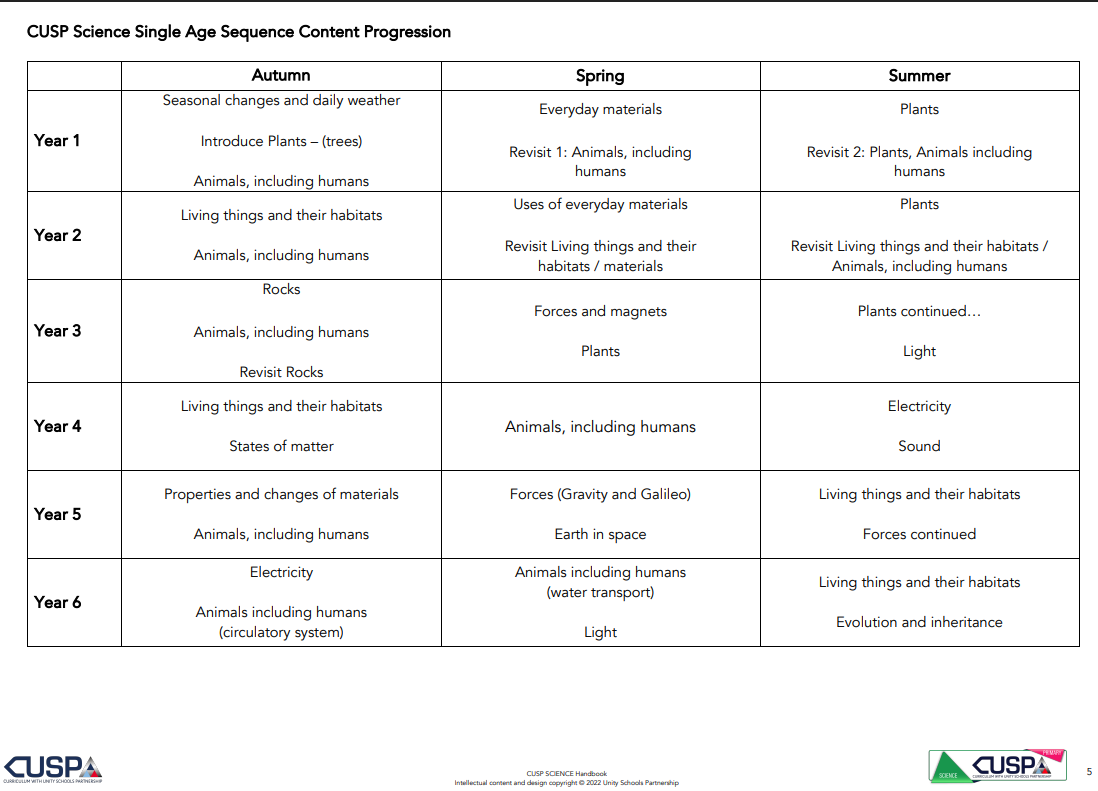
Years 1 - 6 Content Overview
How do our pupils learn?
-
Class timetables have been built to ensure a broad and balanced curriculum.
-
Subjects have been blocked in a spaced retrieval model to support catch up and to build the frequency of science and wider curriculum subjects. This maximises learning time.



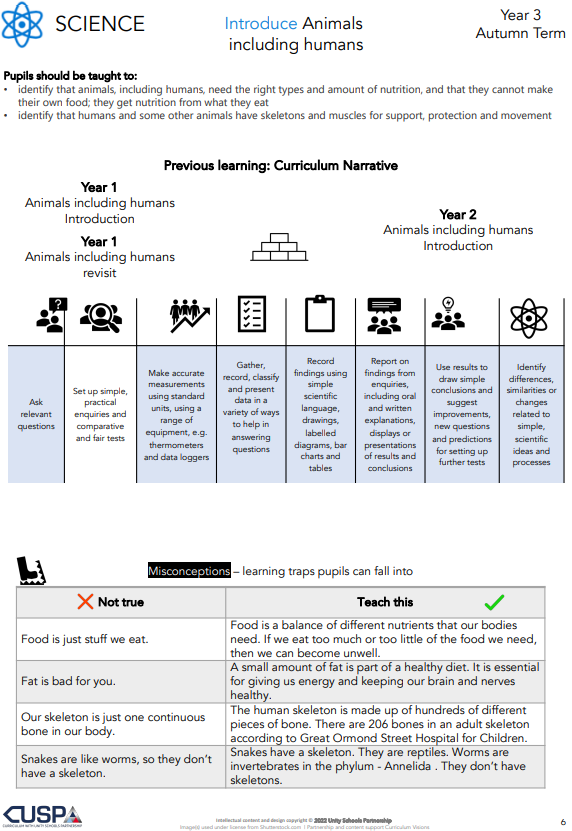
OVERVIEW OF KNOWLEDGE
Each unit includes an overview for the teacher which details the big idea that pupils will be studying, prior knowledge, skills to be taught and common misconceptions.
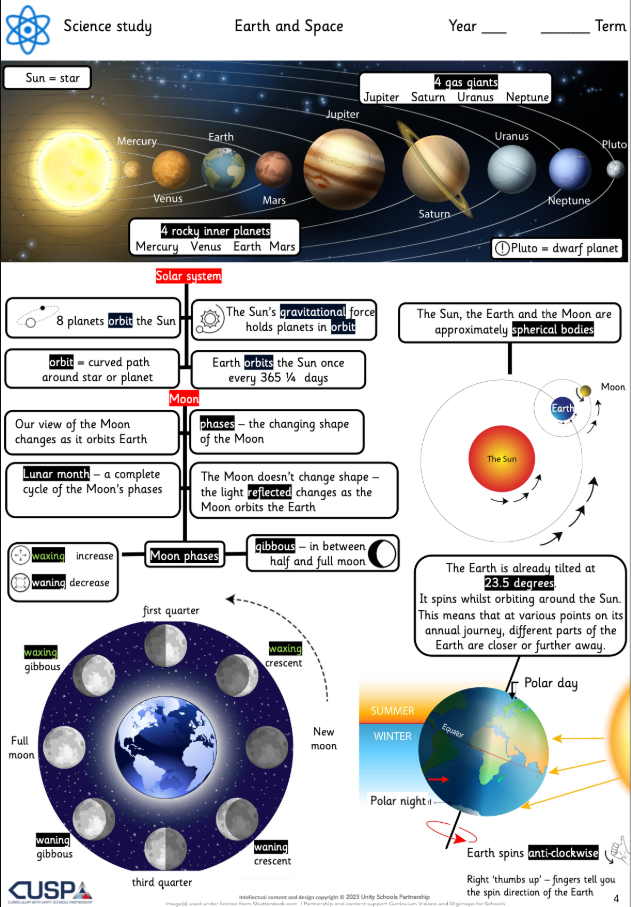
KNOWLEDGE ORGANISERS
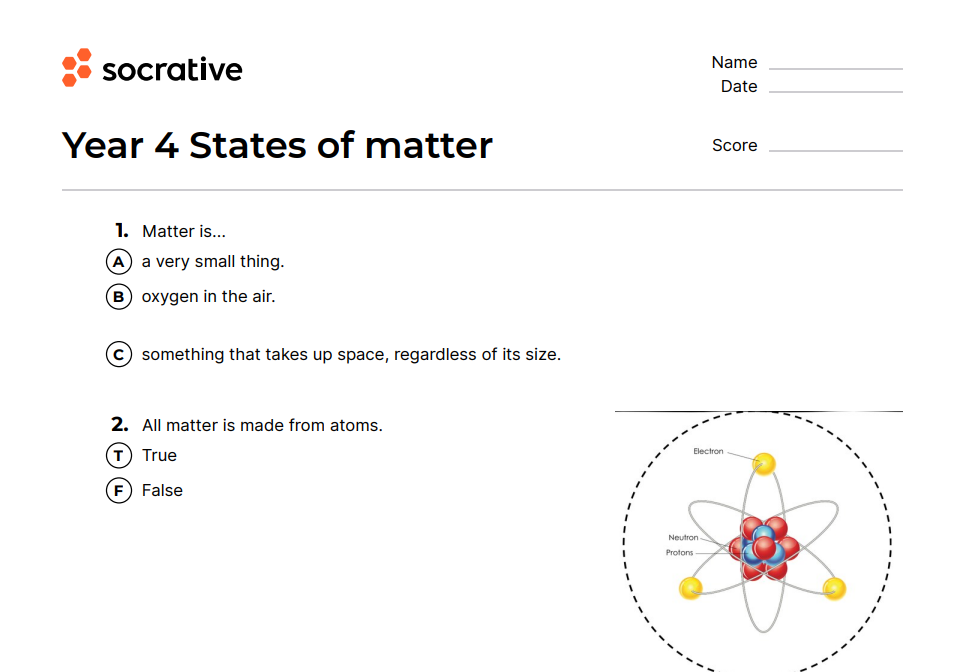
Dual coded knowledge organisers contain core information for children to easily access and use as a point of reference and as a means of retrieval practise.
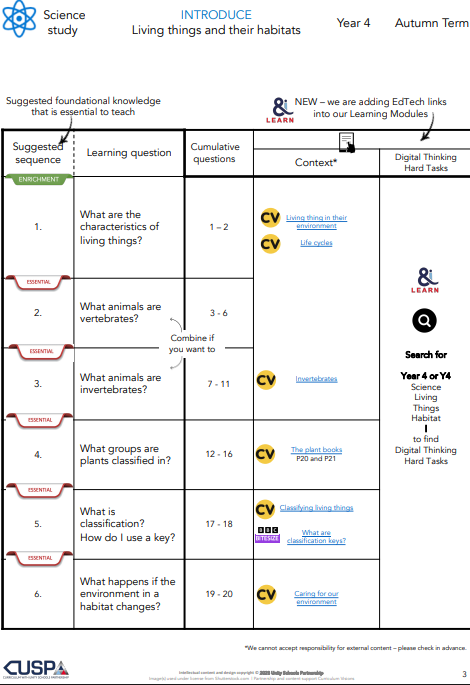
MAPPING OF KNOWLEDGE
The sequence of learning makes clear essential and desirable knowledge, key questions and task suggestions for each lesson and suggested cumulative quizzing questions.
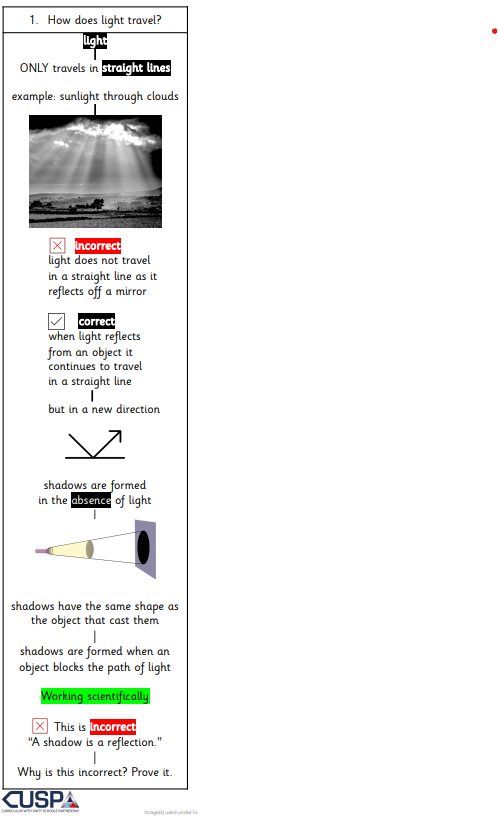
KNOWLEDGE NOTES
Knowledge notes are an elaboration in the core knowledge found in knowledge organisers.
Knowledge notes focus pupils’ working memory to the key question that will be asked at the end of the lesson. It reduces cognitive load and avoids the split-attention effect.
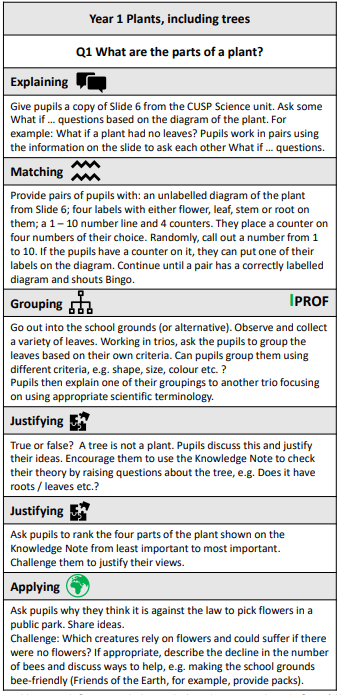
THINKING TASKS
Thinking science tasks are used to engage pupils to think hard about the substantive knowledge, including vocabulary. As part of the ATTEMPT, APPLY OR CHALLENGE phases of a lesson. At the start of a lesson (CONNECT phase) to review and reuse prior knowledge.
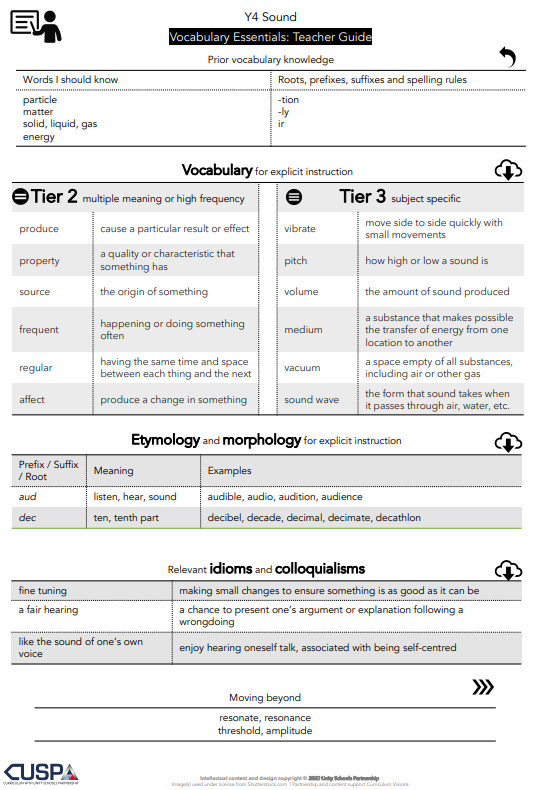
VOCABULARY
The units are supported by vocabulary modules which provide both resources for teaching and learning vital vocabulary and provide teachers with Tier 2 and 3 vocabulary with the etymology and morphology needed for explicit instruction details relevant idioms and colloquialisms to make this learning explicit.
We aim to provide a high challenge with low threat culture and put no ceiling on any child’s learning, instead providing the right scaffolding for each child for them to achieve.
IMPACT
At Phoenix Primary, the impact of our Science curriculum is seen in the confidence, curiosity and achievement of our pupils.
Children make strong and sustained progress from their individual starting points because knowledge is carefully sequenced, deliberately revisited and explicitly connected over time. As a result, pupils develop secure substantive knowledge alongside the ability to work and think scientifically with increasing precision.
By the time children leave Phoenix, they are expected to achieve at least age-related expectations in Science and are well prepared for the next stage of their education.
The impact of our curriculum is also reflected in our Phoenix Values:
-
🔴 Resilience – pupils approach investigations with perseverance and learn from mistakes.
-
🔴 Responsibility – pupils work safely, record findings accurately and understand the role of science in society and the wider world.
-
🔴 Kindness – pupils collaborate respectfully, valuing different ideas and perspectives.
-
🔴 Ambition – pupils use precise scientific vocabulary, reason confidently and see science as a pathway to future opportunities.
Enthusiasm for Science is evident through pupil voice, the quality of discussion, the standard of recorded work and the pride children take in their learning. Our pupils leave Phoenix as curious, knowledgeable and confident young scientists, ready to embrace the scientific opportunities of the future.
How do we know what our children have learnt?
-
Questioning
-
Pupil Book Study talking about learning with the children
-
Talking to teachers
-
Low stakes ‘Drop-in’ observations
-
Quizzing and retrieval practise
-
Feedback and marking
-
Progress in book matches the curriculum intent
PUPIL BOOK STUDY TELLS US:
At Phoenix, we regularly look at pupils’ work to make sure our Science curriculum is having the impact we intend.
1. Is our curriculum making a difference?
We check whether children are building secure knowledge over time and developing a deeper understanding as they move through the school.
2. Is learning lasting?
We look for evidence that teaching helps children remember more, not just complete tasks. We want learning to stick.
3. Are children thinking deeply?
We consider whether activities challenge pupils to think hard, apply what they already know and develop strong, long-term understanding.
This helps us ensure our Science curriculum remains ambitious, engaging and impactful for every child at Phoenix.