Geography
At Phoenix Primary, our children are geographers.
At Phoenix Primary, our Geography curriculum is delivered through CUSP, ensuring that learning is ambitious, carefully sequenced and built to last.
Our intent is to help children make sense of the world around them — from their local community in Liverpool to the wider continents and global environments beyond. We want pupils to understand not just where places are, but why they are like they are, and how people, environments and physical processes are interconnected.
Through CUSP Geography, pupils become increasingly expert as they progress through the school. Knowledge is deliberately accumulated, revisited and connected so that children develop secure understanding of place, space, scale and interdependence. Over time, they grow in confidence to think critically, ask geographical questions and explain patterns, change and relationships using precise vocabulary.
Geography at Phoenix is not only about knowledge of the world — it is about understanding our role within it. Through the study of diverse communities, environmental challenges and global systems, pupils develop the character, awareness and perspective needed to engage positively with the world around them.
🌟 Our Phoenix Values in Geography
🔴 Resilience
Geography encourages pupils to grapple with complex systems, patterns and global issues. Children learn to persevere when interpreting maps, analysing data and understanding how physical and human processes interact over time.
🔴 Responsibility
Through the study of environmental change, sustainability and global development, pupils develop an awareness of their role as responsible citizens. They learn that their actions can have both local and global impact.
🔴 Kindness
Geography nurtures empathy and respect. By learning about diverse cultures, communities and ways of life, pupils develop understanding and appreciation of the similarities and differences that shape our world.
🔴 Ambition
We challenge pupils to think critically, use precise geographical vocabulary and form well-reasoned explanations. Children are encouraged to see themselves as future global citizens, problem-solvers and leaders.
Through engaging fieldwork, practical map work and real-world enquiry, we spark curiosity and encourage purposeful geographical questioning. Children are taught to interpret maps, analyse patterns, compare locations, consider cause and effect, and draw reasoned conclusions using evidence. In doing so, they develop both secure substantive geographical knowledge and the disciplinary skills needed to think like geographers.
We want our children to remember their Geography lessons at Phoenix — to cherish the places they have explored, the communities they have studied and the global connections they have uncovered. Most importantly, we want them to leave us informed, reflective and confident, ready to understand and engage positively with the world around them.
At Phoenix, we are studying CUSP Geography. Through this, pupils become increasingly expert as they progress through the curriculum, accumulating, connecting and making sense of rich substantive and disciplinary knowledge about place, space and environment.
1. What Pupils Will Know – Substantive Knowledge
Substantive knowledge is the subject content and explicit vocabulary pupils use to understand Geography.
In CUSP Geography, this includes four key substantive concepts:
-
Locational Knowledge
-
Place Knowledge
-
Human and Physical Geography
-
Geographical Skills and Fieldwork
These concepts act as golden threads, connecting learning across year groups. Misconceptions are carefully identified and addressed once pupils have constructed secure mental models. New knowledge is deliberately positioned alongside what pupils already know, enabling them to build increasingly coherent geographical understanding over time.
2. What Pupils Will Do - Disciplinary Knowledge
Disciplinary knowledge is how pupils learn to think like geographers.
Pupils develop geographical thinking through:
-
Place and Space
-
Scale and Connection (interdependence)
-
Physical and Human Processes
-
Environment and Sustainability
-
Culture and Diversity
Geographical analysis is developed through selecting, organising and integrating knowledge in response to structured questions and well-designed tasks. Pupils reason, compare, identify patterns and explain cause and effect. Over time, they become increasingly confident in interpreting maps, analysing data and explaining how places are shaped by both human and physical processes.
IMPLEMENTATION
CUSP Geography is built on cumulative knowledge. Each study draws upon prior learning, with deliberate retrieval and practice enabling pupils to connect concepts and think deeply.
What do we teach?
EARLY YEARS FOUNDATION STAGE
In EYFS, Geography is developed through Understanding the World.
Children begin by exploring their immediate environment — school, home and local community — through first-hand experiences. They learn about their city of Liverpool and begin to understand how environments may differ through stories, discussion, role play and small world exploration.
Regular visits within the local community, such as the library, park and local shops, help children develop early place knowledge. Celebrations such as Global Scouse Day strengthen cultural awareness and community identity.
Children are encouraged to observe, ask questions and talk about similarities and differences between places. These rich early experiences lay strong foundations for future geographical learning.
Key Stage 1
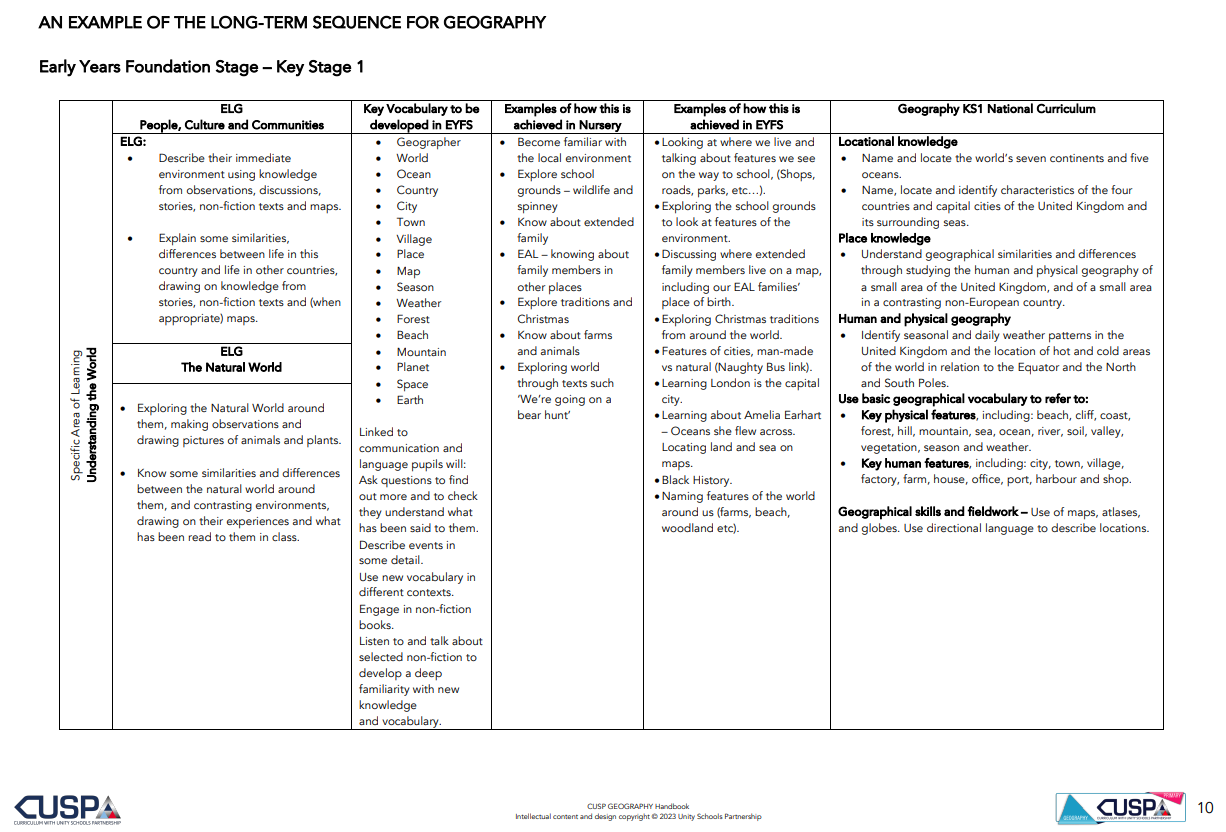
In KS1, pupils develop a secure sense of place, scale and human and physical features.
They begin by learning the 7 continents and 5 oceans, before studying the countries and capital cities of the United Kingdom and surrounding seas. Knowledge is deliberately revisited through increasingly challenging tasks to strengthen long-term memory.
Pupils study contrasting global locations, including non-European regions such as Nairobi and rainforest communities in Brazil and Venezuela. These studies build cultural awareness and deepen understanding of similarities and differences between places.
Fieldwork and map skills are central. Pupils use sketch maps, simple keys, cardinal compass points and OS maps through Digimap for Schools. Through local studies, they apply their knowledge to familiar environments, developing early understanding of distance, scale and orientation.
Lower Key Stage 2
In Lower KS2, pupils deepen their locational knowledge and geographical reasoning.
They revisit map skills, introducing intercardinal compass points and using OS maps with increasing precision. Studies of the UK focus on regions, counties, landmarks and topography, encouraging analysis and pattern seeking.
Pupils apply their understanding of human and physical features to the study of rivers, including the River Nile and the Amazon. They explore latitude and longitude to understand absolute location and global positioning.
The water cycle and climate regions are studied to explain physical processes and geographical patterns. Cultural awareness continues through studies of Europe, Africa, North and South America.
Fieldwork is extended to strengthen pupils’ disciplinary knowledge and ability to reason geographically.
Upper Key Stage 2
In Upper KS2, pupils build increasingly sophisticated geographical understanding.
Biomes and environmental regions are studied in depth, with deliberate retrieval of prior learning about latitude and longitude. Pupils locate world countries and major cities with increasing accuracy.
Four and six figure grid references enhance mapping precision. Terrain is studied through contour lines and advanced OS map work.
Physical processes such as orogeny, glaciation, earthquakes and volcanic activity are explored to explain long-term environmental change. Comparative studies of the Lake District, the Tatra Mountains and the Blue Mountains of Jamaica make abstract concepts concrete.
Settlement, trade and economic activity are examined through links to migration studies, including the Windrush generation. Pupils explore how physical and human features influence where people live and why.
Throughout UKS2, pupils retrieve and reuse prior knowledge, enabling them to reason, explain and think with increasing confidence and precision.
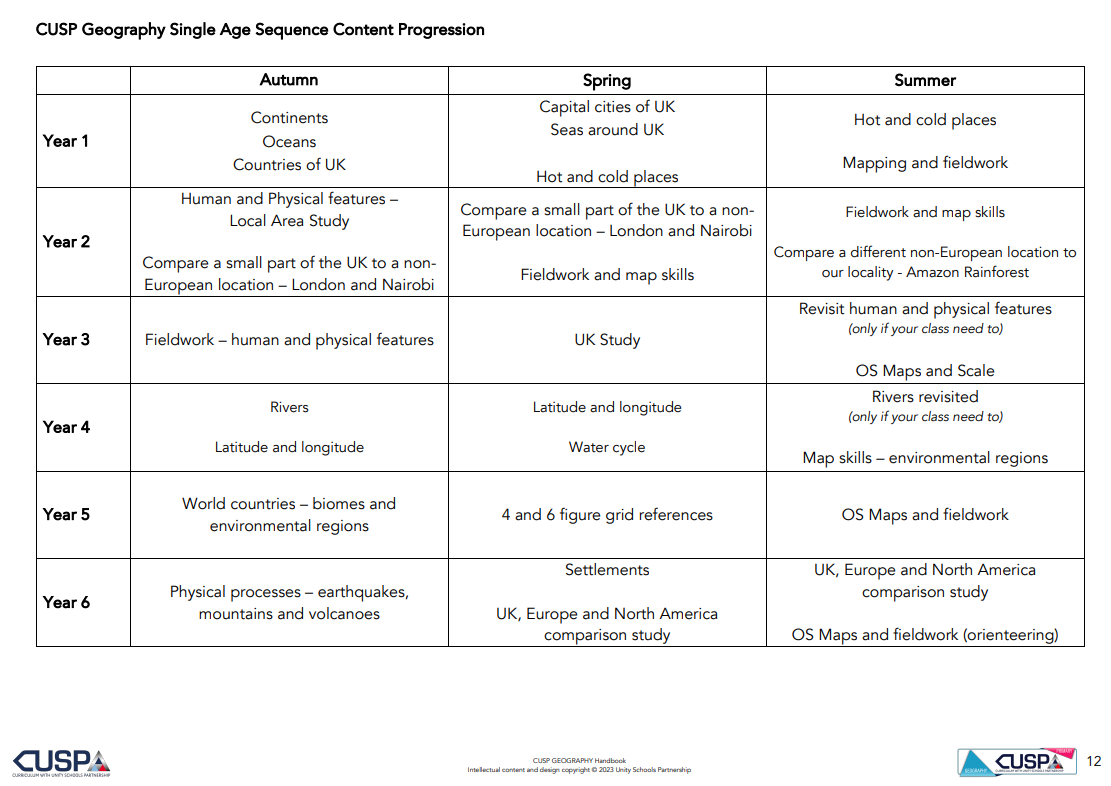
Years 1 - 6 Content Overview
How do pupils learn?
-
Class timetables have been built to ensure a broad and balanced curriculum.
-
Subjects have been blocked in a spaced retrieval model to support catch up and to build the frequency of geography and wider curriculum subjects. This maximises learning time.



OVERVIEW OF KNOWLEDGE
Each unit includes an overview for the teacher which details the big idea that pupils will be studying, prior knowledge, skills to be taught and common misconceptions.
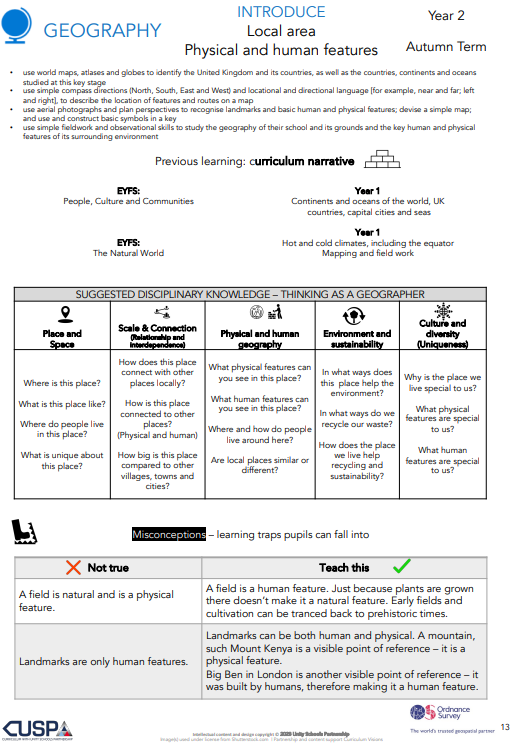
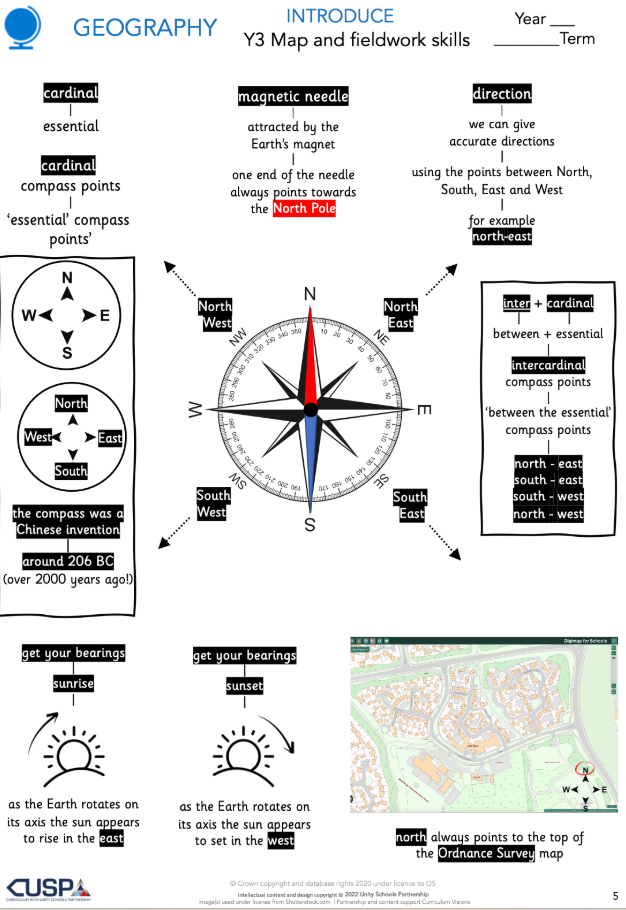
KNOWLEDGE ORGANISERS
Dual coded knowledge organisers contain core information for children to easily access and use as a point of reference and as a means of retrieval practise.
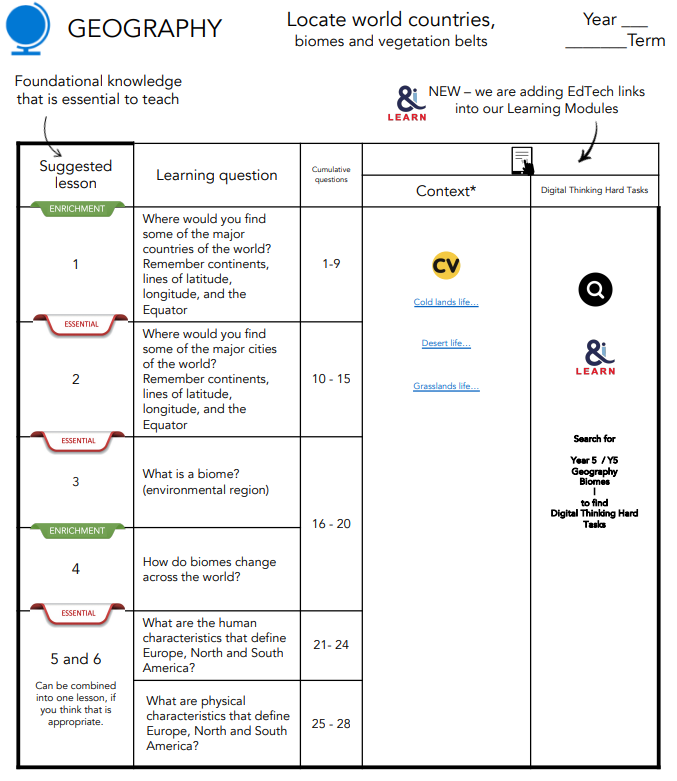
MAPPING OF KNOWLEDGE
The sequence of learning makes clear essential and desirable knowledge, key questions and task suggestions for each lesson and suggested cumulative quizzing questions.
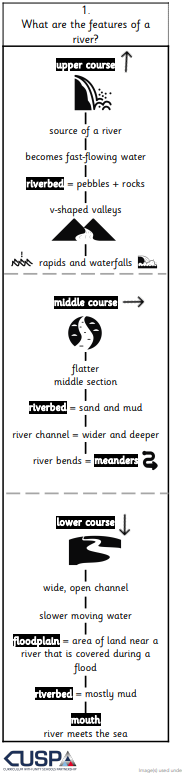
KNOWLEDGE NOTES
Knowledge notes are an elaboration in the core knowledge found in knowledge organisers.
Knowledge notes focus pupils’ working memory to the key question that will be asked at the end of the lesson. It reduces cognitive load and avoids the split-attention effect.
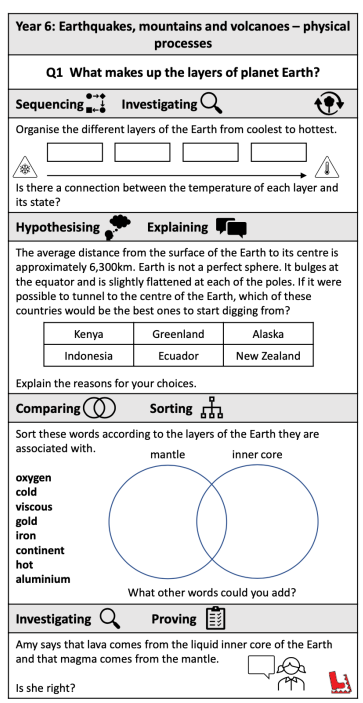
THINKING TASKS
Thinking geographically tasks are used to engage pupils to think hard about the substantive knowledge, including vocabulary. As part of the ATTEMPT, APPLY OR CHALLENGE phases of a lesson. At the start of a lesson (CONNECT phase) to review and reuse prior knowledge.
VOCABULARY
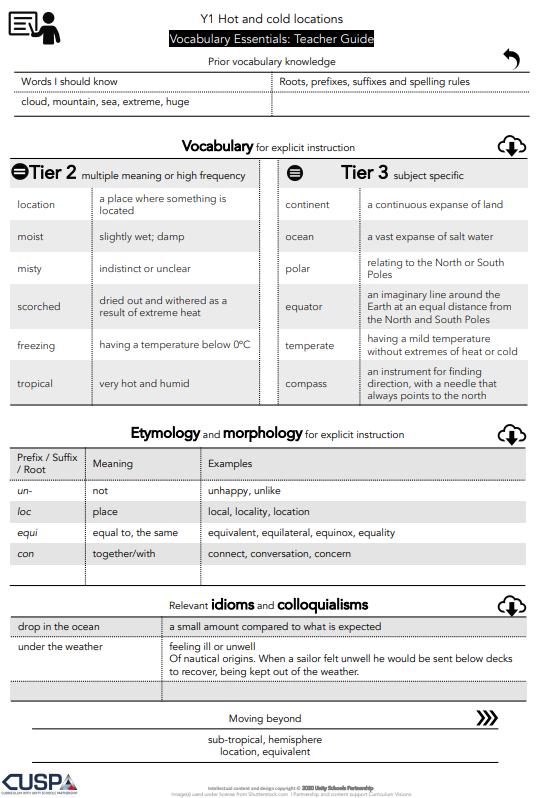
The units are supported by vocabulary modules which provide both resources for teaching and learning vital vocabulary and provide teachers with Tier 2 and 3 vocabulary with the etymology and morphology needed for explicit instruction details relevant idioms and colloquialisms to make this learning explicit.
We aim to provide a high challenge with low threat culture and put no ceiling on any child’s learning, instead providing the right scaffolding for each child for them to achieve.
IMPACT
At Phoenix Primary, the impact of our Geography curriculum is seen in the knowledge, curiosity and global awareness of our pupils.
Children make strong and sustained progress from their individual starting points because learning is carefully sequenced, deliberately revisited and explicitly connected over time.
By the time pupils leave Phoenix, they are expected to achieve at least age-related expectations in Geography and are well prepared to engage thoughtfully with the wider world.
The impact of our curriculum is also reflected in our Phoenix Values:
- 🔴 Resilience – pupils persevere when interpreting maps, analysing patterns and tackling complex global issues.
- 🔴 Responsibility – pupils develop environmental awareness and understand their role as responsible global citizens.
- 🔴 Kindness – pupils show respect and empathy when learning about diverse cultures and communities.
- 🔴 Ambition – pupils use precise geographical vocabulary, think critically and demonstrate confidence in explaining how the world works.
Enthusiasm for Geography is evident through pupil voice, discussion, fieldwork outcomes and the quality of work in books. Our pupils leave Phoenix as informed, reflective and confident young geographers.
How do we know what our children have learnt?
-
Questioning
-
Pupil Book Study talking about learning with the children
-
Talking to teachers
-
Low stakes ‘Drop-in’ observations
-
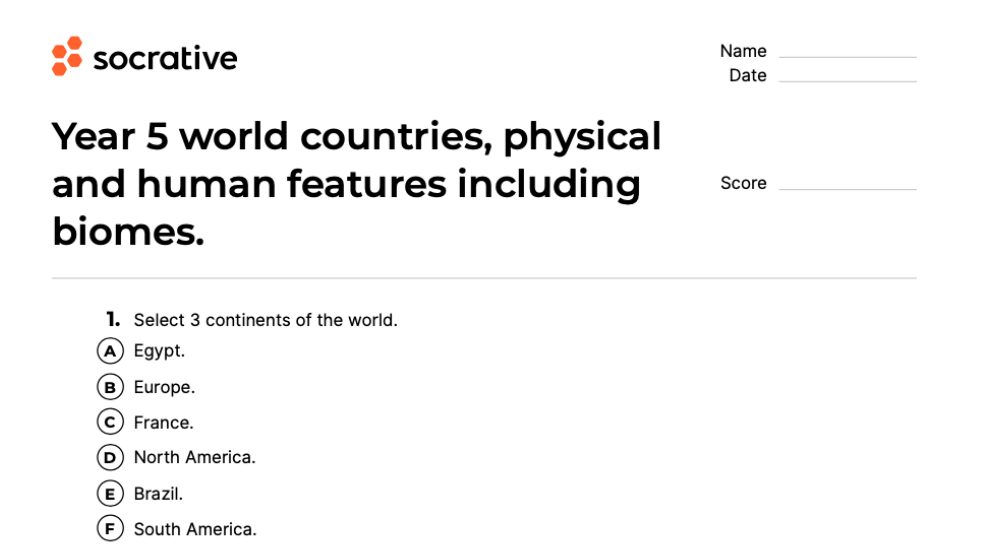
Quizzing and retrieval practise
-
Feedback and marking
-
Progress in book matches the curriculum intent
PUPIL BOOK STUDY TELLS US:
At Phoenix, we regularly look at pupils’ work to make sure our Geography curriculum is having the impact we intend.
1. Is our curriculum making a difference?
We check whether children are building secure knowledge over time and developing a deeper understanding as they move through the school.
2. Is learning lasting?
We look for evidence that teaching helps children remember more, not just complete tasks. We want learning to stick.
3. Are children thinking deeply?
We consider whether activities challenge pupils to think hard, apply what they already know and develop strong, long-term understanding.
This helps us ensure our Geography curriculum remains ambitious, engaging and impactful for every child at Phoenix.