Art & Design
At Phoenix Primary, our children are artists.
At Phoenix Primary, our Art and Design curriculum is delivered through CUSP, ensuring that learning is ambitious, carefully sequenced and built to last.
Our intent is to engage, inspire and challenge pupils while equipping them with the knowledge and skills to experiment, invent and create their own works of art. We want children to understand that art is not only about making something beautiful — it is about expressing ideas, telling stories and communicating meaning.
Through Art and Design, pupils develop an understanding of how creativity has shaped our history and continues to influence culture, identity and society today. From the vibrancy of Liverpool’s artistic heritage to global artists and movements, we want children to see themselves as part of a rich and diverse creative world.
We want our children to love Art. We want them to believe there are no limits to their ambitions — whether they aspire to be illustrators, architects, fashion designers, animators, graphic designers, curators or innovators of the future.
🌟 Our Phoenix Values in Art
🔴 Resilience
Art encourages pupils to experiment, take risks and refine their work. Children learn that creativity involves trial, improvement and perseverance.
🔴 Responsibility
Pupils learn to use tools and materials safely and respectfully. They understand the importance of respecting the work of others and valuing creative expression.
🔴 Kindness
Art nurtures empathy and appreciation. Pupils learn to respond thoughtfully to the work of others and celebrate diversity in artistic style and cultural influence.
🔴 Ambition
We challenge pupils to develop technical precision, expand their artistic vocabulary and push the boundaries of their creativity. Children are encouraged to aim high and see creative careers as possible futures.
Through extended practical sessions, exploration of materials and the study of diverse artists, we spark imagination and encourage purposeful artistic thinking. Children are taught to observe closely, experiment with techniques, refine their work and evaluate outcomes thoughtfully. In doing so, they develop both secure substantive artistic knowledge and the disciplinary skills needed to think and work like artists.
We want our children to remember their Art lessons at Phoenix — to cherish the projects they have created, the artists they have studied and the confidence they have gained. Most importantly, we want them to leave us creative, reflective and confident, ready to express themselves and contribute to the creative world around them.
At Phoenix, we are studying CUSP Art. Through this, pupils become increasingly expert as they progress through the curriculum, accumulating, connecting and making sense of rich substantive knowledge and artistic practice.
1. What Pupils Will Know – Substantive Knowledge
Substantive knowledge is the subject content and explicit vocabulary pupils use to understand Art and Design.
In CUSP Art, this knowledge is organised into carefully sequenced blocks covering the key artistic disciplines:
-
Drawing
-
Painting
-
Printmaking
-
Textiles
-
3D and Sculpture
-
Collage
Vertical progression is deliberately woven throughout the curriculum so that pupils revisit these disciplines with increasing challenge and complexity as they move through school.
Within each discipline, pupils learn about materials, techniques, processes and the work of significant artists, designers and craft makers. Core knowledge is explicitly taught so that children understand how and why artistic effects are achieved, not simply how to replicate them.
Substantive knowledge also includes the explicit teaching of artistic vocabulary and the formal elements of art:
-
Shape – flat (2D) areas defined by outline
-
Line – used to create movement and mood
-
Colour – conveys atmosphere and emotion
-
Value – the lightness or darkness of colour
-
Form – three-dimensional shape
-
Texture – the look and feel of a surface
-
Space – how artists create depth and perspective
These elements act as golden threads across the curriculum, helping pupils to build secure and increasingly sophisticated understanding of artistic composition and design.
2. What Pupils Will Do – Disciplinary Knowledge
Disciplinary knowledge is how pupils learn to think and work like artists.
We call this Working Artistically.
Pupils construct understanding through:
-
Observing closely
-
Experimenting with materials
-
Practising and refining techniques
-
Making creative choices
-
Evaluating and improving their work
Each module develops different aspects of artistic competency. Pupils learn not only how to apply techniques, but how to explain their artistic decisions and intentions.
Through structured reflection and discussion, children analyse the work of artists and designers, consider mood and meaning, and evaluate their own outcomes using precise artistic vocabulary.
Over time, pupils become increasingly confident in selecting appropriate materials, manipulating tools skilfully and articulating their creative thinking. This progression ensures they develop both technical control and creative independence.
IMPLEMENTATION
CUSP Art is organised into blocks, each focusing on a specific artistic discipline. Vertical progression is carefully woven throughout the curriculum so that pupils revisit drawing, painting, printmaking, textiles, 3D and collage with increasing challenge and sophistication.
Art is taught in extended sessions to allow pupils time to explore, experiment and refine their work in depth.
Retrieval practice, vocabulary instruction and structured lesson phases support pupils in building secure artistic knowledge over time.
What do we teach?
EARLY YEARS FOUNDATION STAGE
In EYFS, Art is developed through Expressive Arts and Design.
Children explore a wide range of media and materials, using them in original ways to represent their ideas, thoughts and feelings. They experiment with colour, texture, shape and form through painting, drawing, collage, role play and model making.
Children are encouraged to talk about what they have created and why, developing early artistic vocabulary and confidence. These rich creative experiences lay strong foundations for future artistic development.
Years 1 - 6
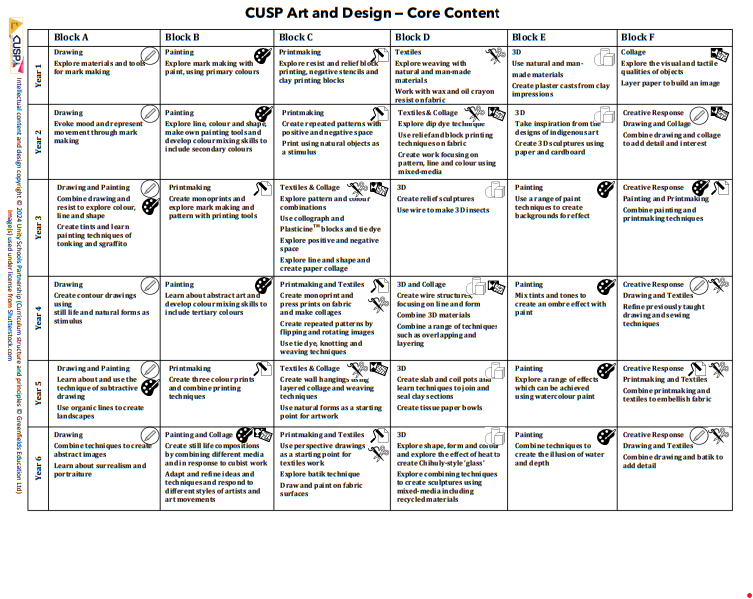
Across Years 1–6, pupils revisit key artistic disciplines — drawing, painting, printmaking, textiles, 3D and collage — with increasing challenge and sophistication.
In Key Stage 1, pupils focus on exploring materials and techniques, developing control and confidence in mark making, colour mixing, texture and form. They begin to study significant artists and learn to talk about their work using simple artistic vocabulary.
As pupils move into Key Stage 2, they deepen their understanding of artistic processes and refine their technical skill. They learn to make increasingly deliberate choices about materials, composition and technique. Study of diverse artists, designers and craft makers supports pupils in understanding how art reflects culture, history and identity.
Throughout Years 1–6:
-
The formal elements of art — shape, line, colour, value, form, texture and space — are explicitly taught, revisited and developed.
-
Pupils experiment with and combine techniques, building control and precision over time.
-
Vocabulary is explicitly taught and revisited so pupils can articulate their artistic thinking with confidence.
-
Progression is carefully sequenced so that knowledge and skill build cumulatively across year groups.
-
Each year culminates in a Creative Response, where pupils draw together the techniques and knowledge acquired to produce a more independent and personal outcome.
By Upper Key Stage 2, pupils demonstrate increasing control, creativity and confidence. They are able to select appropriate materials independently, justify their artistic decisions and evaluate outcomes thoughtfully, showing a secure understanding of both technique and artistic intention.
How do pupils learn?
-
Class timetables have been built to ensure a broad and balanced curriculum.
-
Subjects have been blocked in a spaced retrieval model to support catch up and to build the frequency of art and wider curriculum subjects. This maximises learning time.



OVERVIEW OF KNOWLEDGE
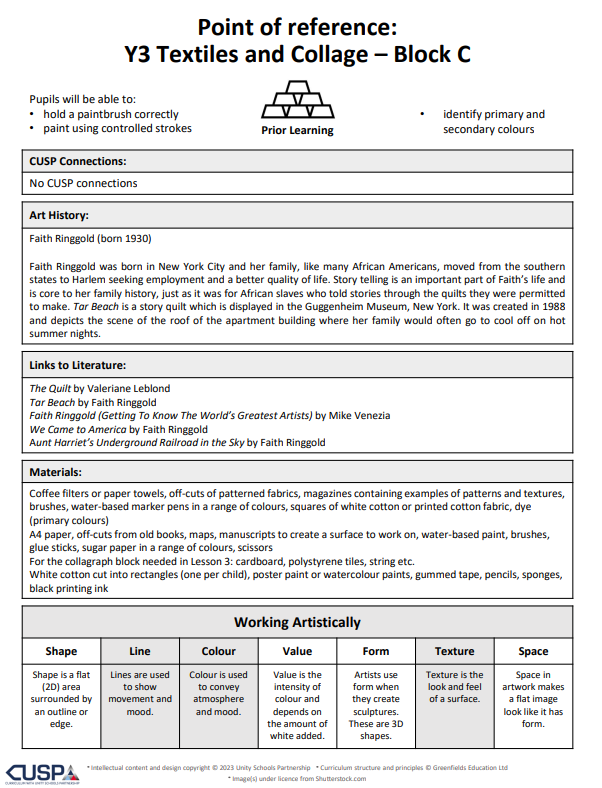
Each unit includes an overview for the teacher which details the Art History, Links to Literature, Materials and which aspects of Working Artistically are the focus.
MAPPING OF KNOWLEDGE
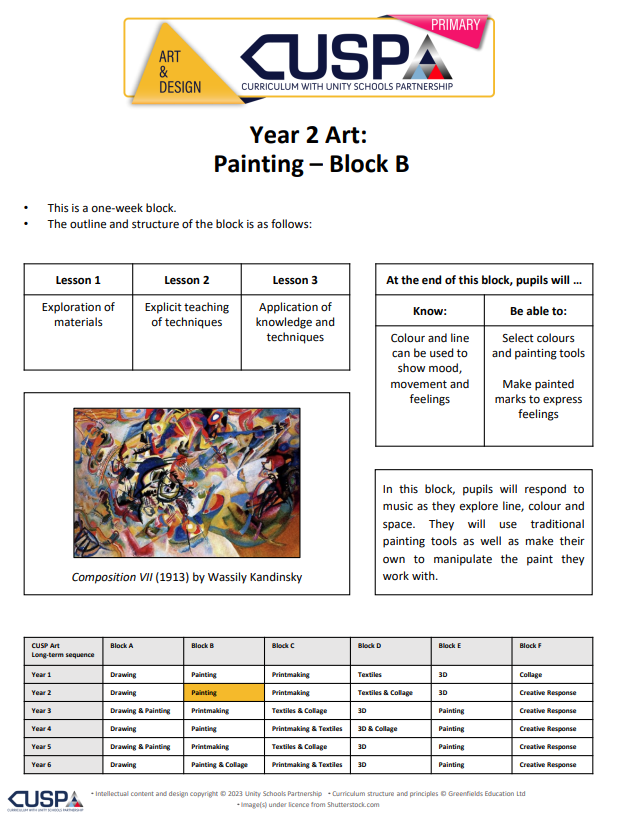
The sequence of learning makes clear essential and desirable knowledge, key questions and task suggestions for each lesson and suggested self evaluation questions.
KNOWLEDGE NOTES
Knowledge notes are an elaboration in the core knowledge found in knowledge organisers.
Knowledge notes focus pupils’ working memory to the key question that will be asked at the end of the lesson. It reduces cognitive load and avoids the split-attention effect.
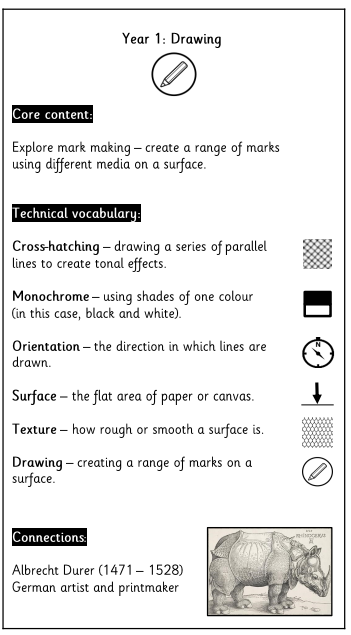
VOCABULARY
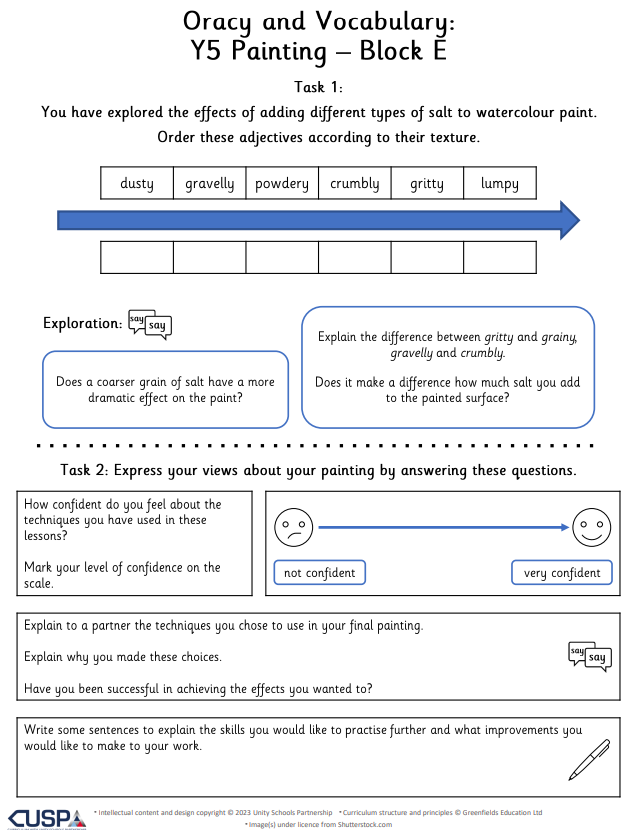
The units are supported by vocabulary modules which provide both resources for teaching and learning vital vocabulary and provide teachers with Tier 2 and 3 vocabulary with the etymology and morphology needed for explicit instruction.
We aim to provide a high challenge with low threat culture and put no ceiling on any child’s learning, instead providing the right scaffolding for each child for them to achieve.
Inclusion
At Phoenix, all pupils participate fully in Art and Design.
We recognise that some pupils may require adaptations to access materials or processes. Teachers consider how lessons can be adjusted to ensure all pupils can participate meaningfully.
This may include:
-
Visual prompts or task boards
-
Breaking tasks into manageable steps
-
Adjusting tools or materials for sensory or motor needs
-
Providing alternative media where required
Our aim is high challenge with low threat — placing no ceiling on any child’s creativity, while providing the right scaffolding for each pupil to succeed.
IMPACT
At Phoenix Primary, the impact of our Art curriculum is seen in the creativity, confidence and technical skill of our pupils.
Children make strong and sustained progress from their individual starting points because learning is carefully sequenced and revisited over time. As a result, pupils develop increasing control, creativity and confidence in applying artistic techniques.
By the time pupils leave Phoenix, they are expected to achieve at least age-related expectations in Art and Design and are well prepared to continue their creative journey in secondary education and beyond.
The impact of our curriculum is also reflected in our Phoenix Values:
- 🔴 Resilience – pupils refine and improve their work through thoughtful evaluation.
- 🔴 Responsibility – pupils respect materials, tools and creative spaces.
- 🔴 Kindness – pupils respond positively and thoughtfully to the work of others.
- 🔴 Ambition – pupils demonstrate creativity, precision and pride in their artistic outcomes.
Enthusiasm for Art is evident through pupil voice, the quality of displayed work and the pride pupils take in their creations. Our children leave Phoenix as confident, expressive and imaginative young artists.
How do we know what our children have learnt?
At Phoenix, assessment in Art is purposeful, ongoing and rooted in pupils’ development as artists.
Assessment is primarily formative and takes place within lessons, as pupils experiment, refine and reflect. Teachers use questioning, discussion and observation to assess pupils’ understanding of artistic techniques, processes and vocabulary.
Each block makes expectations explicit. Teachers are clear about what pupils should know and be able to do by the end of the unit — for example, selecting appropriate tools to create specific marks, combining techniques effectively or using colour deliberately to convey mood.
Assessment is supported through:
-
Exemplification materials, which demonstrate expected standards and support teacher subject knowledge.
-
Point of Reflection sections, which clarify the intended outcome of each lesson.
-
Questions for Assessment, which probe pupils’ understanding of tools, techniques and artistic effects.
-
Oracy and vocabulary tasks, which assess pupils’ ability to use artistic language accurately and confidently.
-
Vocabulary quizzes, which check deeper understanding of technical and disciplinary terminology.
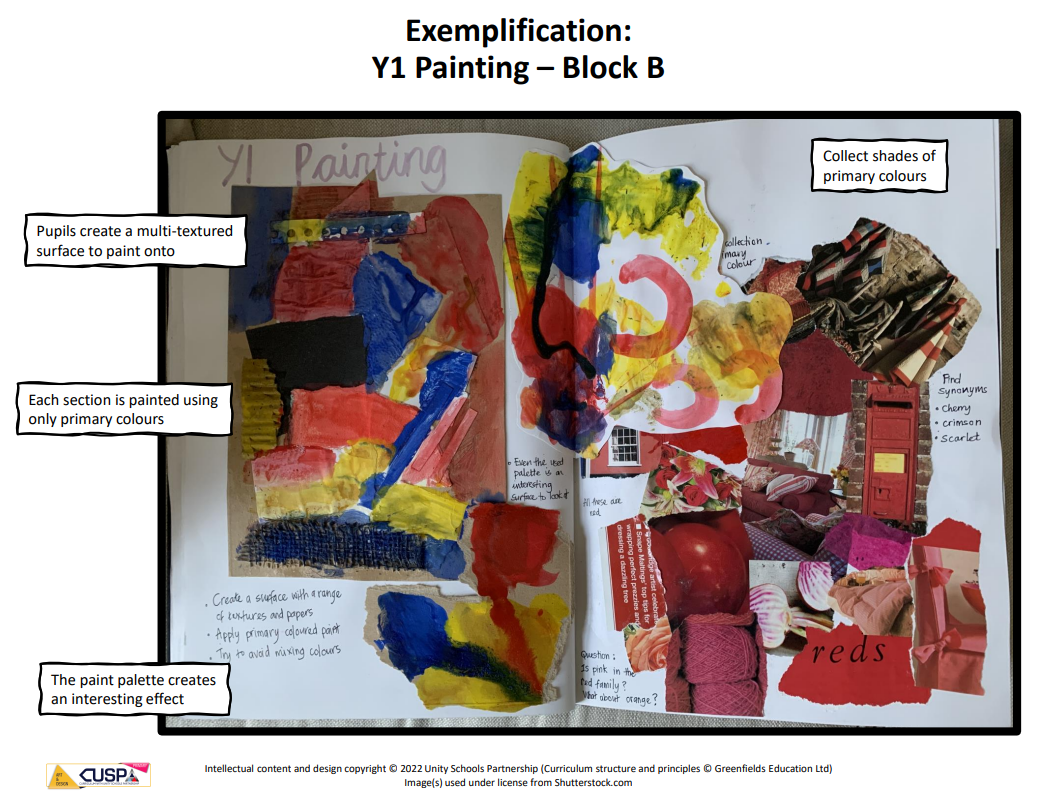
Assessment in Art happens as children create. As pupils explore materials and refine their work, teachers observe their choices, techniques and responses to feedback. Through conversation and reflection, we see their growth as artists — not just the finished piece.
Self-evaluation encourages confidence, resilience and independence, while maintaining high expectations for creativity and skill.
PUPIL BOOK STUDY TELLS US:
At Phoenix, we regularly look at pupils’ work to make sure our Art & Design curriculum is having the impact we intend.
1. Is our curriculum making a difference?
We check whether children are building secure knowledge over time and developing a deeper understanding as they move through the school.
2. Is learning lasting?
We look for evidence that teaching helps children remember more, not just complete tasks. We want learning to stick.
3. Are children thinking deeply?
We consider whether activities challenge pupils to think hard, apply what they already know and develop strong, long-term understanding.
This helps us ensure our Art & Design curriculum remains ambitious, engaging and impactful for every child at Phoenix.